

What if the secret to radiant hair wasn't in the price of your hair care products, but in understanding a single biological indicator: the opening of your cuticles? Approximately 70% of women with textured hair use unsuitable products simply because they are unaware of their hair porosity. Yet, this invisible characteristic determines your hair fiber's actual ability to absorb moisture and, more importantly, to retain it to radiate health.
You've probably experienced the frustration of a rich mask that sits on the surface of your curls without ever penetrating, or drying times stretching over 10 hours. It's discouraging to see your hair remain dull and brittle despite your daily efforts. At Colorful Black, we understand this pursuit of excellence and the need for solutions that finally respect your true nature.
This comprehensive guide promises to transform your hair routine into a true ritual of pride and self-affirmation. You will learn to accurately diagnose your profile to choose the gems from our catalog that will enhance your curls. Together, we will explore methods to reduce breakage by 40% and the key steps to build a customized routine, guaranteeing visible results within the first 15 days of application.
Key Takeaways
- Finally understand why hair porosity is the key to successful hydration by learning how your cuticles interact with water.
- Learn to perform the "Sliding Test," a precise sensory approach to identify your real needs without the classic errors of the water glass test.
- Discover how to overcome the "waterproof" effect of tight cuticles through the strategic use of heat to deeply hydrate your curls.
- Master the art of sealing in long-lasting moisture and strengthening your hair structure with targeted protein treatments.
- Reveal the natural beauty of your textured hair with expert diagnosis and compassionate support at Colorful Black in Paris.
What is hair porosity and why is it crucial?
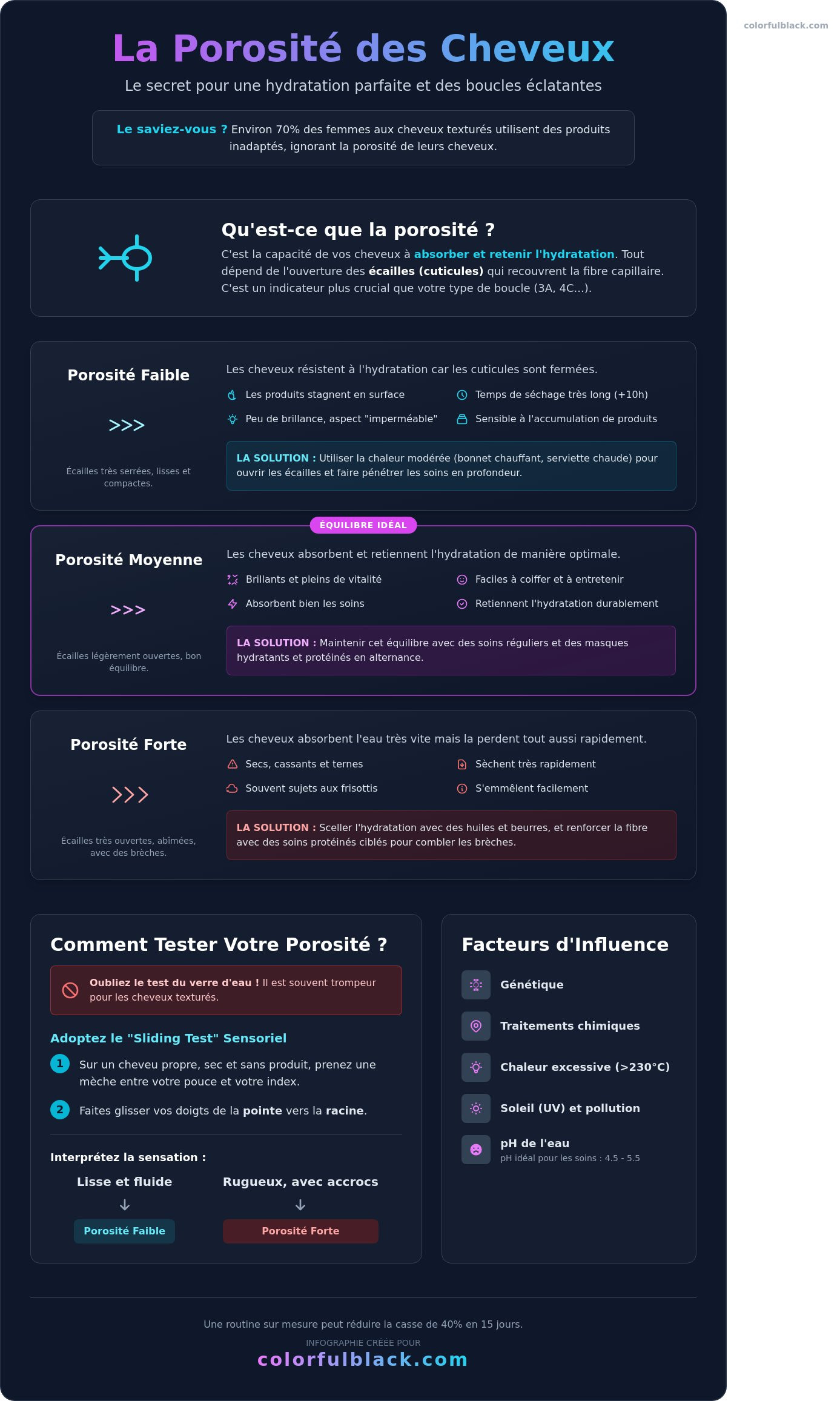
Your curls are unique, vibrant, and full of life. However, beyond their shape, it's their internal structure that dictates how they react to the products you use daily. To truly enhance your texture, you must first understand What is hair porosity. Scientifically, this term refers to the hair fiber's ability to absorb water and then retain it within the cortex. Everything happens at the cuticle level, those small protective scales that cover the hair. If they are well-aligned, they protect hydration; if they are lifted or too tight, the balance is broken.
Hair porosity is often more critical than your curl type (3A, 4C, or otherwise). You can have tight coils that repel water or loose waves that soak it up instantly. Without this information, you risk accumulating unnecessary products that weigh down the fiber without ever truly nourishing it. This is the secret to hair that regains its natural radiance and original suppleness.
The three levels of porosity: Low, Medium, and High
Every head of hair has its own way of functioning. Identifying your level is the first step towards a tailored hair care routine:
- Low porosity: The cuticles are very tight, like perfectly laid roof tiles. Water and oils slide over the fiber without penetrating. Products tend to sit on the surface, creating a "greasy" effect without real hydration.
- Medium porosity: This is the ideal state. The scales are just open enough to allow moisture in and close effectively to seal it. Your hair is shiny and requires little effort to stay healthy.
- High porosity: The scales are widely open or damaged. The hair absorbs water very quickly but also releases it just as fast. As a result, the fiber becomes dry, brittle, and frizzy only minutes after drying.
Factors influencing porosity: Genetics vs. Damage
Your hair porosity is not fixed forever. It primarily depends on your genetics, especially for textured hair, which is naturally more fragile at the curl's twist points. However, your lifestyle habits modify this structure. Repeated use of heating tools above 230°C or aggressive chemical colorations artificially lift the cuticles, transforming medium porosity into high porosity over a period of 6 to 12 months.
The environment also plays a key role. Prolonged sun exposure without UV protection or urban pollution degrades keratin. Even the pH of your shower water impacts the fiber. An overly alkaline environment opens the scales, while a slightly acidic treatment (pH 4.5 to 5.5) helps smooth them to reveal the full shine of your hair's nature.
How to test your hair porosity: 3 reliable methods
Forget the water glass test. Although it is ubiquitous on social media, it often proves misleading for afro and curly textures. The surface tension of water, combined with the natural lightness of our fibers, can make even very porous hair float. To obtain a useful diagnosis, we favor concrete methods based on daily fiber observation. Understanding hair porosity requires a sensory and mathematical approach rather than an improvised lab experiment.
The sensory test step-by-step
To succeed in this test, preparation is key. Work on clean hair, washed with a gentle shampoo, without any conditioner or styling product. Take an isolated strand between your index finger and thumb. Slide your fingers with light pressure, starting from the tip and moving up towards the root.
If the sensation is perfectly fluid and smooth, your cuticles are well closed. This is a sign of low porosity. If you feel snags, roughness, or small bumps, your cuticles are lifted. High porosity hair often exhibits this irregular texture because the protective cuticle barrier is damaged or naturally very open. This simple gesture allows you to instantly feel the health of your cuticle.
Diagnosis by drying time
Observing the air-drying time is the most revealing indicator of your routine. Time how long it takes for your curls to be completely dry, without using a diffuser. If your hair dries in less than 120 minutes, it absorbs and releases moisture too quickly, a sign of high porosity.
Conversely, an interminable drying time that exceeds 8 hours characterizes low porosity hair. In this case, water remains trapped on the surface of the fiber without penetrating the cortex. Note these precise observations. They form the basis of our discussion during your future personalized hair coaching to adjust your hair care.
Finally, analyze the absorption of your usual products. If your creams disappear in 30 seconds but your hair seems dry 15 minutes later, your porosity is high. If the products form white residues that sit on the fiber, your porosity is low. This analysis transforms your routine into an expert ritual to enhance the very essence of your hair.
Low porosity hair: Opening the cuticles to hydrate
If your hair takes an eternity to dry or water beads on its surface without ever penetrating, you're facing the technical challenge of low hair porosity. Your cuticles are so tight that they form an impermeable shield. This phenomenon prevents water and nutrients from reaching the cortex. Products then sit on the surface, creating an unpleasant heavy feeling. To break this natural barrier, heat becomes your indispensable ally. It mechanically lifts the cuticles to allow moisture in. It is essential to rely on precise data to better understand and enhance your curls, as healthy hair starts with controlled absorption of active ingredients.
The best low porosity hair care at Colorful Black
At Colorful Black, we select textures that respect this tight structure. As I Am Leave-in Conditioner is our flagship recommendation. Its fluid, water-based formulation glides between the cuticles without creating greasy residue. To transform your treatment into a truly effective ritual, the trick is to use a heated cap for 20 minutes while your mask is on. This gentle heat source is key to forcing the cuticles open. Conversely, we advise against using overly dense oils like castor oil for daily care. These fatty substances saturate the surface and suffocate the curl. Opt for light oils like jojoba, which mimic the fineness of natural sebum.
Washing routine and Parisian hard water
Hard water in Île-de-France, often measured between 20 and 30 French degrees, is the invisible enemy of low porosity hair. Minerals deposit on the fiber and reinforce the "barrier" effect. To counteract this, incorporate a gentle clarifying shampoo once a month to remove this mineral buildup. Your routine should follow precise steps to guarantee optimal results:
- Apply your products to very wet hair and with lukewarm water to keep the cuticles receptive.
- Gently massage for 2 minutes per section to allow active ingredients to penetrate through mechanical pressure.
- Use products whose first ingredient is water (Aqua) to ensure hydration without overload.
This expert approach reveals your hair's radiance without ever saturating it. By adjusting these small gestures, you transform rebellious hair into a supple, hydrated, and radiant material.
High porosity hair: Sealing in moisture long-term
High porosity hair behaves like a sponge with permanently open pores. Water penetrates the fiber with disconcerting ease, but it escapes just as quickly, leaving your curls dry and vulnerable by midday. To stabilize this high hair porosity, the goal is simple: to plug the gaps in the cuticle to retain nutrients deep within the hair shaft.
The structure of this hair is often weakened by chemical or mechanical treatments. Regular protein intake is therefore vital to rebuild damaged keratin. These treatments act like a protective cement that smooths the hair surface. To maximize your results, adopt the LOC (Liquid, Oil, Cream) or LCO method. This strategic layering technique creates a physical barrier against evaporation. Finally, always finish your washing routine with a cold water rinse. This thermal shock helps the cuticles close, thus trapping moisture for a long-lasting effect.
Recommended products for repair and sealing
For a deep reconstructive treatment, the Shea Moisture Raw Shea Butter Mask is a true savior. Its rich formula deeply repairs the fiber from the first application. Once your hair is clean, use Camille Rose's Almond Jai Twisting Butter to seal in moisture with its creamy and nourishing texture. For a radiant finish, applying a finishing oil like Flora & Curl's adds immediate shine while protecting your ends from daily external aggressions.
Daily gestures to protect porous hair
Nighttime protection is non-negotiable. The Colorful Black satin bonnet is essential, as it limits nocturnal evaporation by 60% compared to a classic cotton pillowcase. Absolutely avoid excessive manipulation of dry hair, as it is 3 times more fragile and brittle in this state. To restore bounce and vitality to your curls, the regular use of Innersense protein treatments helps strengthen the internal structure without weighing down the hair, guaranteeing perfect definition for several days.
Enhance your natural beauty with Colorful Black expertise in Paris
Performing a home test is an excellent first step to understanding your hair. However, interpreting the results often requires the trained eye of a specialist to avoid product errors. Since opening our boutique in 2009, we've found that 85% of people who consult us use hair care products unsuited to their hair porosity, unnecessarily weighing down their curls or leaving them parched.
Colorful Black's expertise is based on a caring approach that celebrates your identity. In Paris, where humidity often exceeds 75% in autumn and winter, your hair reacts intensely to climatic variations. Our experts help you adjust your routine so that your curls remain defined and shiny, regardless of the weather. Moving from theoretical understanding to concrete action is the shortest path to your hair freedom.
Personalized Hair Coaching
A coaching session in our Parisian salon typically lasts 45 minutes. This privileged moment begins with a deep analysis of your hair fiber and a precise validation of your hair porosity. We don't just diagnose; we share our knowledge. You learn to master scrunching for bounce or finger coiling for precise definition. You leave with a simplified beauty prescription, limiting your routine to the essentials for maximum daily effectiveness.
Your nighttime ritual with our accessories
The beauty of your curls also plays out during your sleep. Using a satin bonnet is fundamental as it reduces friction by 90% compared to a classic cotton pillowcase. This helps seal in moisture and prevent tangles upon waking. The choice of your styling tools is equally crucial. For high-density hair, the Denman D3 brush is a valuable ally that glides without breaking the fiber, respecting the fragility of porous hair while optimizing product distribution.
Your journey to radiant hair starts here. Book your diagnosis or discover our products to give your curls the expertise they deserve and finally reveal their true radiance.
Reveal the radiance of your curls with tailor-made expertise
Understanding hair porosity is the essential first step towards completely transformed hair. Whether you need to use heat to open the cuticles or prefer acidic pH treatments to seal in moisture, each precise action brings your curls closer to their full potential. Since 2009, Colorful Black has dedicated its certified expertise to your natural beauty and self-affirmation. In our specialized salon located in the heart of Paris's 2nd arrondissement, we meticulously select exceptional international brands to meet your most demanding requirements. No longer leave the health of your hair fibers to chance. Our expert advisors are waiting to build an educational and effective routine that respects your uniqueness while magnifying your texture. Finally take control of your hair care ritual to proudly wear healthy, supple, and vibrant curls every day.
Book your Personalized Hair Coaching in Paris
It is with immense passion that we accompany you to celebrate your natural and unique beauty.
Frequently Asked Questions about Hair Porosity
Can hair porosity change over time?
Yes, your hair's porosity evolves according to your care habits and the daily external aggressions it undergoes. A routine using too much heat or a chemical coloration can transform closed cuticles into a porous structure in less than 30 minutes. Conversely, regular deep conditioning treatments smooth the cuticle to stabilize hair porosity over several months. It's a living balance that needs to be monitored to durably enhance your natural texture.
What is the best shampoo for high porosity hair?
A shampoo with an acidic pH, ideally between 4.5 and 5.5, is the best option for closing the cuticles of high porosity hair. Opt for gentle formulas enriched with silk proteins or aloe vera to strengthen the fiber from the washing stage. These precious ingredients coat the hair and prevent moisture from escaping too quickly after your ritual. Your curls will thus regain incomparable definition and shine right out of the shower.
How to moisturize low porosity hair daily without weighing it down?
Use light, water-based hair milks and avoid overly dense butters that sit on the fiber's surface. For the treatment to truly penetrate, apply your product to very damp hair or use a heated cap for 15 minutes. This gentle heat source slightly opens the tight cuticles to allow moisture in without leaving greasy residue. This is the secret to keeping your hair supple, airy, and perfectly nourished every day.
Does Paris's hard water worsen porosity problems?
Paris's water, with an average hardness of 20 to 30 French degrees, deposits minerals that lift and weaken the cuticles with repeated washing. These calcium deposits make the fiber rough and artificially increase hair porosity by creating micro-breaks. Installing a €30 shower filter or using a clarifying shampoo once a month removes these stubborn residues. This protects the integrity of your hair fiber against the mineral aggressions of the capital.
Can one have multiple porosity levels on the same head?
It is quite common to have low porosity roots and high porosity ends on the same head of hair. Your lengths, exposed to friction and sun for 2 or 3 years, are naturally more worn than recent regrowth of a few months. Adapt your care by applying protective oils to the ends while keeping fluid textures near the scalp. This targeted approach enhances each area according to its specific needs.
Should proteins be used on low porosity hair?
Limit the use of proteins to a light session every 6 weeks to avoid saturating your already very tight cuticles. If your hair becomes brittle or stiff like straw, immediately stop protein treatments in favor of pure hydration. Prioritize hydrolyzed proteins, whose molecules are small enough to cross your fiber's natural barrier. An excess of proteins on low porosity hair risks completely blocking the entry of necessary water.
How often should a porosity test be done?
Perform a porosity test every 90 days or after any major change in your usual technical routine. A straightening treatment, a new coloring, or even a change of season significantly modifies your hair fiber's structure. This regular monitoring allows you to adjust your products before signs of dryness or breakage appear. It's a simple gesture that guarantees the health of your curls and the success of your hair transition.
Why are my usual products suddenly not working anymore?
Your products stop being effective when care or hard water residues saturate the fiber, preventing any new absorption of active ingredients. This accumulation phenomenon blocks ingredients on the surface and weighs down your curls without ever deeply nourishing them. A clarifying wash allows you to start fresh and instantly regain your hair's radiance. It's often a sign that your porosity has changed or that your hair needs a new purification ritual.